Why can music sound out of tune after sudden hearing loss?
Sudden hearing loss often affects one ear. Alongside the loss itself, many people notice that music sounds wrong: out of tune, doubled or sour. Here's why, and what matters most.
By the developer of Harmonic Recovery, who has diplacusis · not a clinician · Last reviewed September 25, 2026
First: if it's happening now, go today
Sudden sensorineural hearing loss (SSNHL, or "sudden deafness") is hearing that drops over
hours or up to three days, usually in one ear. It's a medical emergency:
See a doctor immediately, at urgent care or an ENT. Say "sudden hearing loss in one ear".
Treatment works best early. US guidelines say doctors may offer steroids
within two weeks of the loss starting. Treatment delayed by more than two to four weeks is
less likely to help.
Don't assume it's wax or a cold without a doctor looking. The two can feel
similar at first.
About half of people with sudden hearing loss recover some or all of their hearing on their
own, usually within one to two weeks. It affects roughly 1 to 6 people in every 5,000 each
year, and probably more, since many cases go undiagnosed.
Why pitch changes along with hearing
Your inner ear sorts sounds by pitch along its length, and your brain reads pitch partly from
where a sound makes it vibrate. An injury to the inner ear in one ear can shift that
map, so the same note lands in a slightly different place and sounds like a different pitch
in that ear. That is binaural diplacusis.
Because sudden hearing loss usually hits one ear, the two ears end up disagreeing. People
notice it most with music: a familiar song sounds detuned, a singer seems flat, chords clash.
Researchers have measured this directly: in one documented case of sudden hearing loss in one
ear, the two ears heard the same tones up to 12% apart in pitch at high frequencies. That's
about two semitones.
Does the pitch come back?
In that same case, the patient was treated with steroids. Their hearing thresholds recovered
fully by four weeks, and the diplacusis went back to normal a little later. That's a single
case, not a study, but it shows pitch can recover along with hearing.
When hearing doesn't recover fully, the mismatch can remain. There's no research yet on how
it changes over months or years after sudden hearing loss, though adult pitch perception can
adapt. Read what's known about whether diplacusis goes away.
After the urgent phase
Once a doctor has assessed and treated the loss:
Keep your follow-up hearing tests. They show how much hearing has come back.
Tell your audiologist about the pitch. A standard hearing test measures how
quiet a sound you can hear, not what pitch you hear, so it won't show diplacusis unless you
mention it.
Track it yourself. Measuring your pitch mismatch the same way every week or
two shows whether it's improving, holding or getting worse, which is useful to share with
your audiologist.
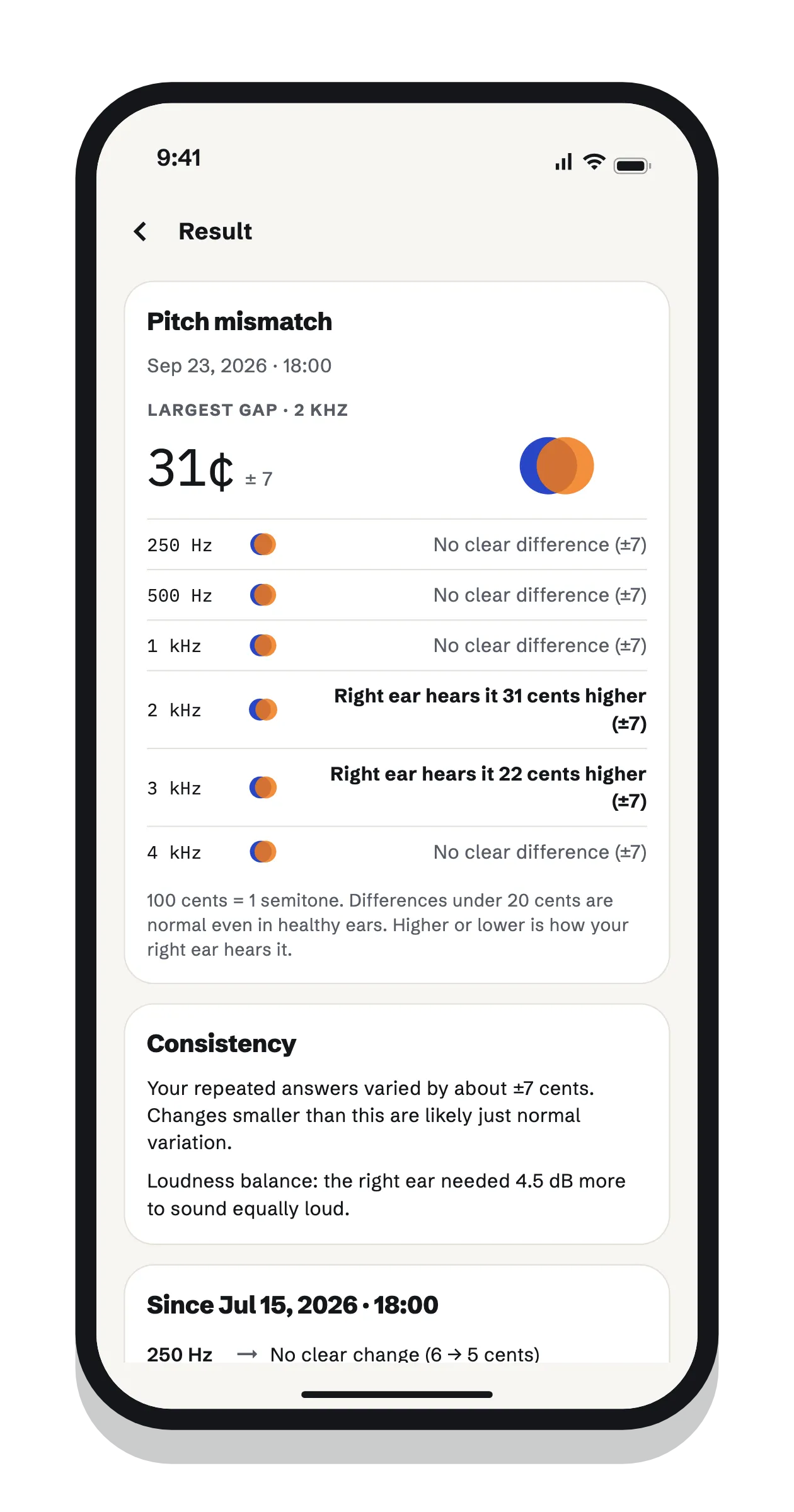
That's what Harmonic Recovery was built for. It measures the gap between your ears in cents
at six frequencies, with a setup that keeps measurements comparable over time. It also lets
you practice with your own music, with a pitch hint in your better ear. It doesn't treat
sudden hearing loss or replace your doctor's care. See how it works.
This page summarizes published research and public health sources for general
information. It is not medical advice. An ENT or audiologist can examine your ears and
tell you what applies to you.
Harmonic Recovery
Measure it properly, and practice with your own music
A headphone setup tuned to each of your ears, a pitch-matching check at six frequencies,
a pitch hint that plays in your other ear while you listen to your own songs, 3-minute
drills, and a chart that shows whether anything is changing. Free to start.
On a computer? Scan with your phone's camera to open the app in its store.